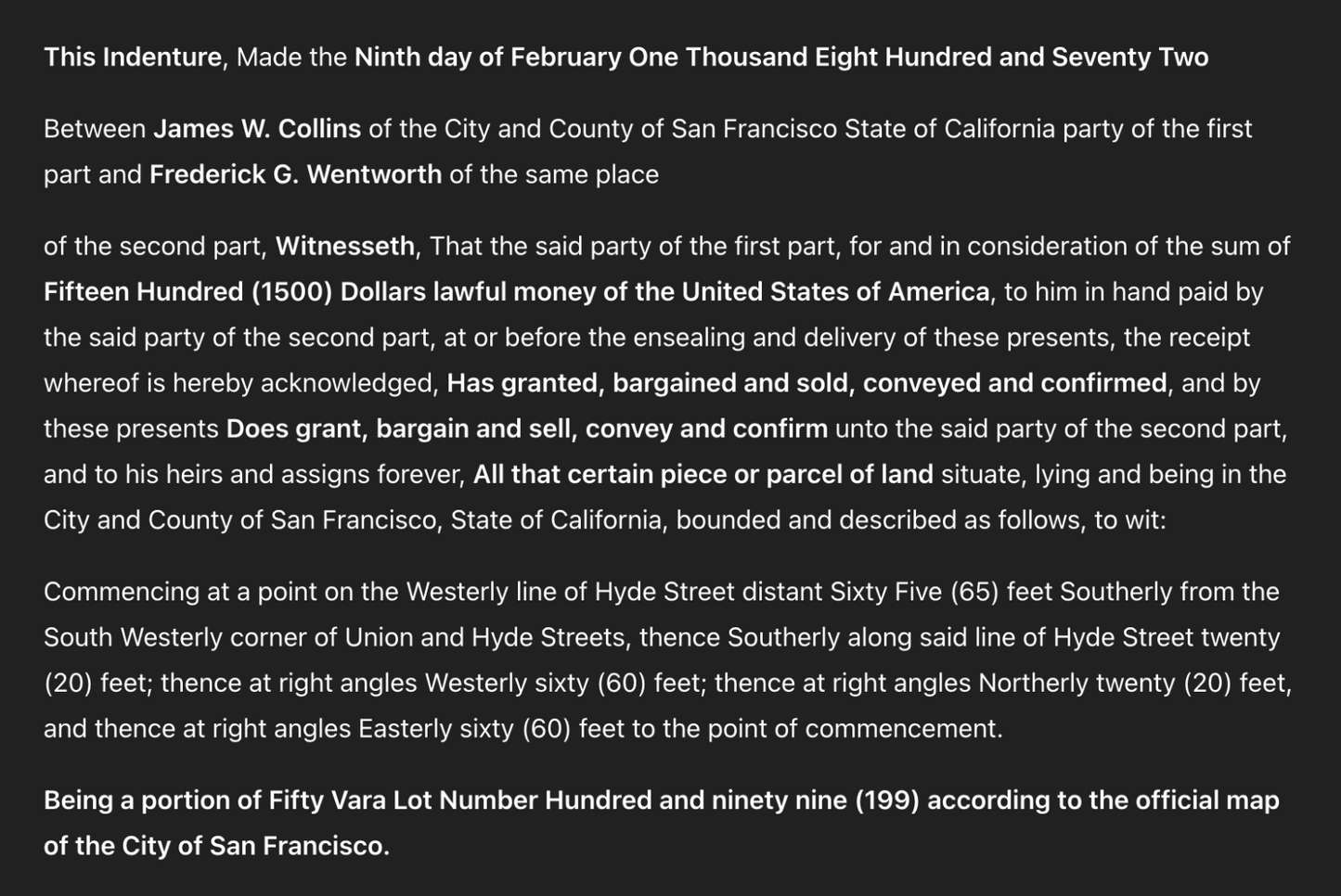
This large-format property deed documents an 1872 real estate transfer in San Francisco, California, during a critical period of post–Gold Rush urban consolidation.
The decades following the California Gold Rush witnessed one of the most rapid urban transformations in American history, as San Francisco evolved from a chaotic port settlement into a fully structured city governed by formal property law, surveyed streets, and recorded land ownership. What had once been a landscape of informal claims, tents, and wooden buildings gave way to a dense urban grid as population growth, capital investment, and municipal authority demanded legal clarity. By the 1870s, deeds, plats, and recorded conveyances became the backbone of San Francisco’s expansion, allowing land to be bought, sold, financed, and developed with confidence.
This 1872 property deed belongs squarely within that moment of consolidation and maturation. Dated February of that year, it records a transfer of real estate between James M. Allen and Frederick J. Worthington, both residents of the City and County of San Francisco. The document follows the formal indenture style typical of nineteenth-century California deeds, establishing consideration, transfer of ownership, and full legal conveyance under state law. The stated purchase price of seven hundred dollars represents a meaningful urban investment at the time, reflecting the rising value of centrally located city property as San Francisco continued to push westward from its original waterfront core.
The parcel itself is described through a detailed metes-and-bounds survey, beginning at a point on Union Street and extending toward Hyde Street, situating the property in a neighborhood that was actively being built out during the post–Civil War era. The careful measurements, directional angles, and references to street intersections demonstrate the increasingly professional surveying practices adopted by the city as it imposed order on its rapidly growing street system. Such descriptions were critical in preventing boundary disputes and ensuring that ownership could be defended, transferred, or mortgaged without ambiguity.
Beyond the land alone, the deed explicitly conveys all associated rights, improvements, and appurtenances, a standard but essential clause that ensured buildings, structures, and future developments were legally included in the transfer. The attached certification and red wax seal confirm that this instrument was formally executed and intended for permanent record, not casual correspondence. The folds, wear, and handling marks visible today are consistent with a working legal document that would have been consulted repeatedly over decades as property changed hands or was developed.
As a historical artifact, this deed serves as a primary-source record of San Francisco’s transition from frontier city to established metropolis. It ties named individuals to a precise location, documents real estate values at a fixed point in time, and preserves the exact legal language that governed ownership in nineteenth-century California. The item shown in the listing is the exact item the collector will receive.
We have tens of thousands of items to choose from. Shipping will always be combined (or refunded) to save you as much money as possible. Please contact us with any questions, or visit our store page for specifics.