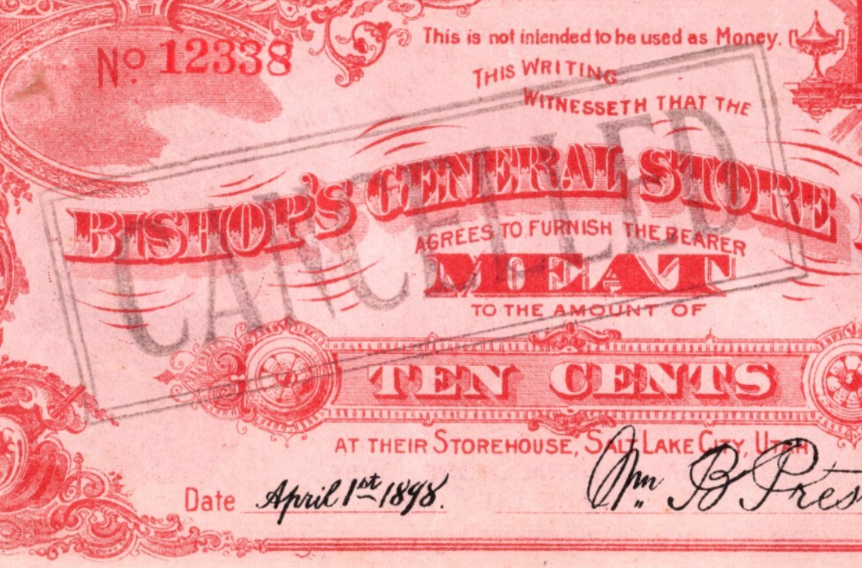
Bishop's General Store 1898 Meat Scrip Currency Cancelled Salt Lake City UT
Bishop's General Store 1898 Meat Scrip Currency Cancelled Salt Lake City UT
30-day returns accepted. If an item is not as described, contact us and we’ll make it right.
Couldn't load pickup availability
This nineteenth-century meat scrip note was issued in Salt Lake City, Utah, in 1898 by Bishop’s General Storehouse as part of a controlled local provisioning system.
Private scrip played an important role in American local economies during the late nineteenth century, particularly in regions where cash circulation was limited or where businesses and institutions sought to retain trade within defined commercial networks. Issued by stores, employers, or community organizations, scrip functioned as a substitute currency redeemable for specific goods rather than legal tender. In many western communities, scrip was commonly used for necessities such as groceries, fuel, clothing, or meat, allowing households to obtain essential items during periods of cash scarcity. While often associated with mining or company towns, merchant-issued scrip was also widely used by religious, cooperative, and community-based enterprises, especially throughout the Intermountain West.
Issued by Bishop’s General Storehouse and denominated in ten cents, the note reflects food-specific redemption consistent with controlled distribution practices. The central vignette depicting the Salt Lake Temple underscores the close relationship between commerce and the Church of Jesus Christ of Latter-day Saints during this period. Bishop’s Storehouses operated under local church leadership and formed part of a broader system intended to provide food and essential goods to members of the community, often through welfare distribution or cooperative economic efforts. Meat scrip such as this would have circulated within that system, reinforcing principles of self-sufficiency and mutual aid as Salt Lake City continued to grow in the late nineteenth century. The presence of cancellation marks indicates redemption, transforming the note from a transactional instrument into a documented artifact of everyday economic life.
Today, merchant and institutional scrip from nineteenth-century Utah is valued as a primary-source record of how frontier and religious communities structured their economies outside conventional banking systems. Examples tied directly to Salt Lake City and LDS-affiliated institutions are especially sought after, as they reflect the distinctive blending of faith, governance, and commerce that shaped the region’s development. Survivors are relatively uncommon, since scrip was typically destroyed after use, making cancelled examples particularly important evidence of circulation rather than unused remainders. This note offers a tangible link to food distribution, community organization, and daily life in Salt Lake City during the 1890s.
The item shown in the listing is the exact item the collector will receive. We have tens of thousands of items to choose from. Shipping will always be combined or refunded to save you as much money as possible. Please contact us with any questions, or visit our store page for specifics.
Share